
Colonial History of Eritrea: From Ottoman Ports to Italian Colony
Between the years 1557 and 1890
The Ottomans Seize Massawa
In the mid-16th century, the Ottoman Empire extended its reach down the African coast of the Red Sea, occupying the strategic harbour city of Massawa and establishing a foothold on the most coveted shore in the region. The Ottomans subsequently appointed the Naib of Massawa as their governor of the coastal territories, formalising administrative control over the port and its surrounding districts. This single act would set in motion a colonial drama that would play out across more than three centuries.
The inland Kingdom of Medri Bahri — centered at Debarwa and ruled by the Bahri Negassi, the King of the Sea — now found itself caught between two imperial powers. The Abyssinian Empire pressed from the south and southwest, while the Ottomans dominated from the east and north, and the Bahri Negassi navigated this pressure by shifting alliances tactically to preserve the kingdom's independence.
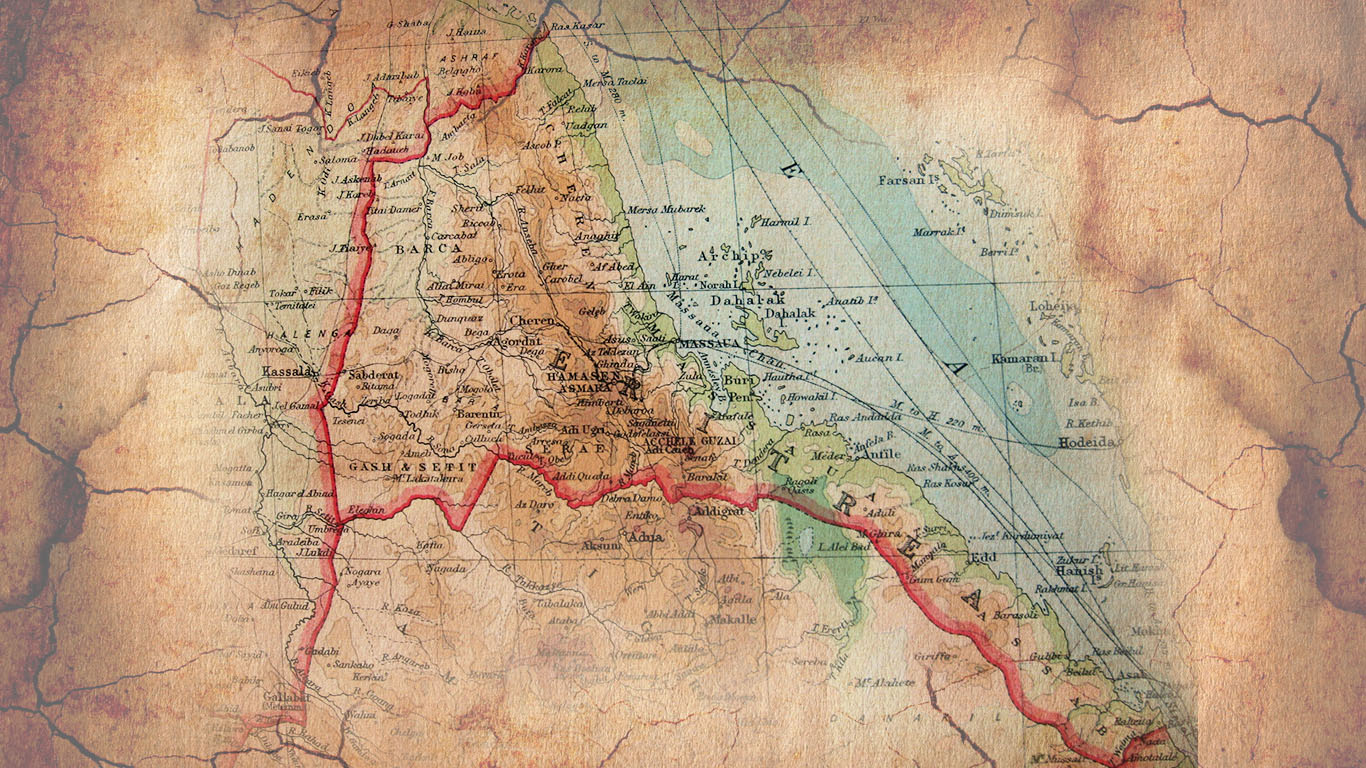 Italian colonial map of Eritrea, circa 1890
The Age of Princes and Egyptian Ambitions
As the Abyssinian Empire fractured during the ዘመነ መሳፍንት — the Age of Princes — real power passed from the emperor to provincial warlords who raided and pillaged the highland territories of Mereb Mellash at will. The capital of Medri Bahri moved to the rising house of Tsazzegga in the central highlands, but the kingdom remained exposed to constant disruption from both Abyssinian princes and coastal powers. It was an era of brutal raids, shifting loyalties, and a land bled by competing rulers with no clear authority.
Egypt, under the modernising Khedive, had taken over Ottoman Red Sea territories by the mid-19th century and launched repeated campaigns to extend its control inland — seizing Massawa and fortifying Keren and Hamasien. Emperor Yohannes IV of Abyssinia fought the Egyptians in several engagements, defeating them in pitched battle more than once, but could not dislodge them from the northern highlands of Bogos or the coastal lowlands. The region remained a contested prize, caught between the ambitions of two declining empires.
Italy's Entry: Assab, Massawa, and the Interior
The opening of the Suez Canal in 1869 transformed the strategic value of the Red Sea and drew a new colonial power into the picture. Italy, eager to secure its share of the Scramble for Africa, purchased a small strip of land at Assab — at the southernmost tip of modern Eritrea — from local Danakil chieftains. From this modest foothold Italy expanded steadily northward, eventually landing troops at Massawa as Egyptian power on the coast collapsed.
With the death of Emperor Yohannes IV at the Battle of Metema in 1889, the power vacuum in the northern highlands opened the door to rapid Italian expansion. Local chiefs were imprisoned, entire communities displaced, and sweeping land laws were imposed that transferred vast tracts of highland and lowland territory to the Italian colonial state.
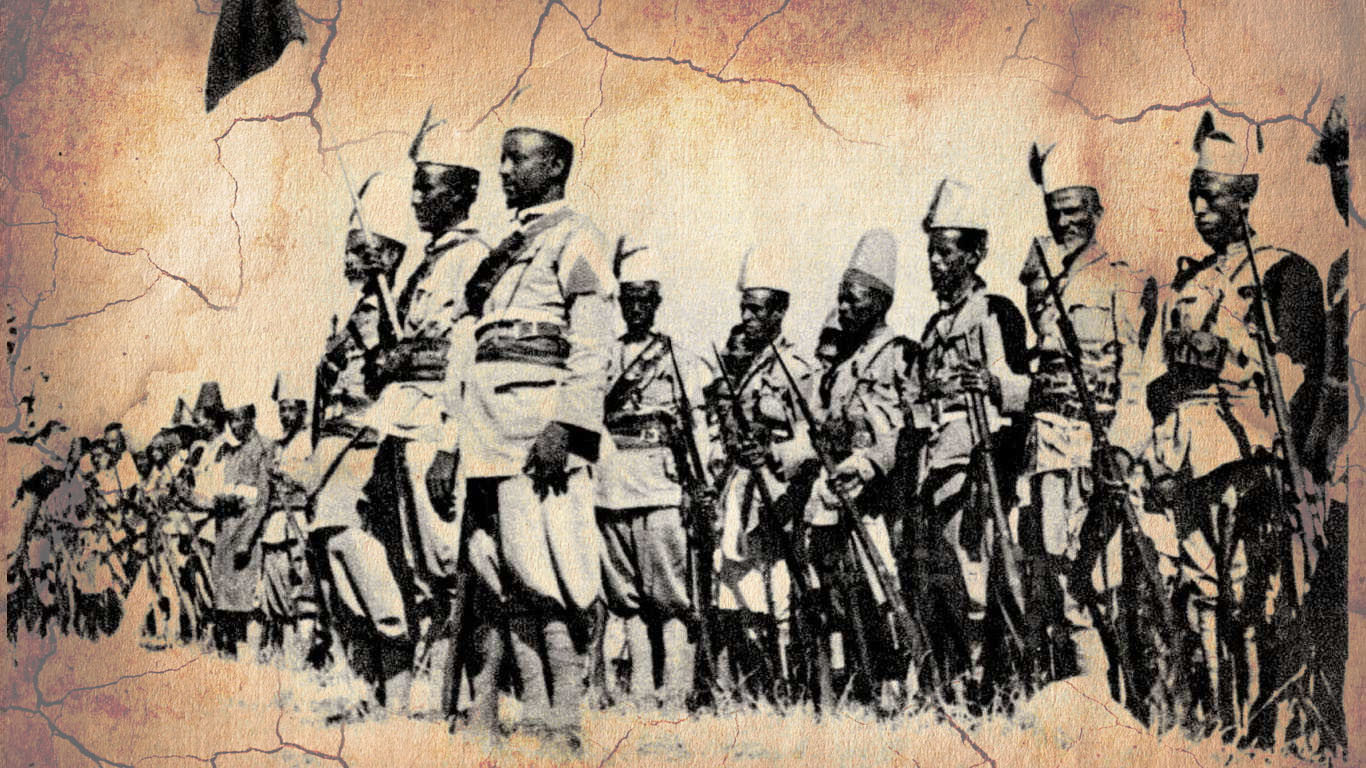 Eritrean soldiers conscripted into the Italian colonial army — the Ascari
Resistance: The Rebellion of Bahta Hagos
Not all Eritreans accepted Italian rule without a fight. In 1894, Dejazmach Bahta Hagos of Segeneiti led an armed uprising against Italian authority, rallying highland fighters in open rebellion. The rebellion of Bahta Hagos was ultimately crushed, but it signalled the depth of resistance that colonial rule would face in the highlands — and it became a foundational moment in the memory of Eritrean resistance to foreign occupation.
Menelik II, the Treaty of Wuchale, and the Battle of Adwa
Further south, Emperor Menelik II of Ethiopia chose negotiation over confrontation — at first. The Treaty of Wuchale of 1889 outlined the territories under Italian control, effectively acknowledging Italian authority over what would become Eritrea in exchange for Menelik's own political ambitions. When a dispute arose over the treaty's meaning and Italy attempted to impose a full protectorate over Ethiopia, Menelik fought back — and decisively defeated Italian forces at the Battle of Adwa in 1896, one of the most celebrated African victories over a European colonial army.
Adwa halted Italian expansion into Ethiopia but left the territories already occupied — the Eritrean coastal plains, central and northern highlands, and western lowlands — firmly in Italian hands. The boundaries of Eritrea as a distinct entity were now effectively drawn.
The Colony of Eritrea Is Declared
On 1 January 1890, Italy formally declared the establishment of the Colony of Eritrea, taking the name from Mare Erythraeum — the ancient Roman name for the Red Sea. For the first time in history, the territories of modern Eritrea were unified under a single administration and a single name. The extraordinary and turbulent story that followed — Italian rule, British administration, federation with Ethiopia, and the long liberation struggle — would forge the national consciousness that brought an independent Eritrea into being on 24 May 1991.