
Ancient History of Eritrea: Kingdoms of the Red Sea
Between the years 0100 and 1557
A Land Born at the Crossroads
Eritrea's identity as a coherent political entity was formally established only in 1890, with the declaration of an Italian colony. Before that, its territories were ruled by a succession of shifting kingdoms, empires, and alliances — none of which drew the precise borders we recognise today. Yet for thousands of years, the lands that make up modern Eritrea were among the most strategically important in the ancient world.
The Red Sea coastline gave Eritrea something rare: direct access to the world's most important maritime trade routes. Whoever controlled that shore could project power and wealth in every direction — to Arabia, to India, to Egypt, and beyond. It was this geography, more than any other force, that shaped the history of its people.
Adulis: The Ancient Port on the Gulf of Zula
Around the 1st century AD, a Greek merchant traveller documented the sea routes of the known world in a text called the Periplus of the Erythraean Sea. Among the thriving ports he described was Adulis — a well-developed city and trade hub on the Red Sea, positioned on the Gulf of Zula in what is now Eritrea. Romans, Arabs, and Indian merchants all passed through its harbour, making it one of the great commercial nodes of the ancient world.
Adulis was intimately linked to the ancient D'mt kingdom, and later became the primary maritime gateway of the rising Aksumite Empire. Excavations at the site have uncovered warehouses, temples, and the ruins of a Byzantine basilica — testament to centuries of continuous settlement and international commerce.
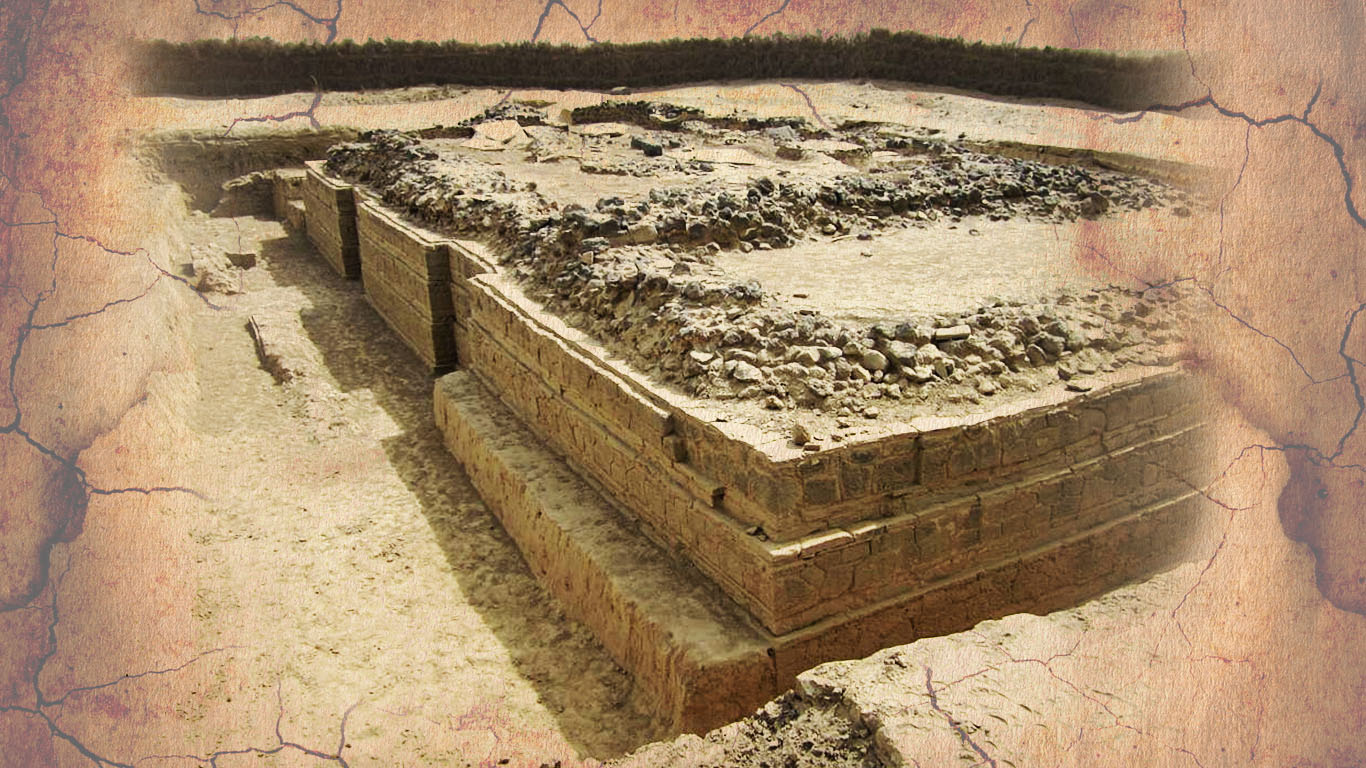 Ruins of a Byzantine basilica from the 5th century at Adulis
The Aksumite Empire: One of the Four Great Powers
The Aksumite Empire rose south of modern Eritrea and grew into one of the most formidable civilisations of the ancient world. In its 6th-century heyday, it dominated a vast territory spanning modern-day Eritrea, northern Ethiopia, eastern Sudan, Yemen, and southern Saudi Arabia — placing it alongside Persia, Rome, and China as one of the four great powers of its era.
Aksum minted its own gold coins, raised enormous stone obelisks, and became one of the earliest kingdoms on earth to adopt Christianity as its state religion, in the 4th century. All of this wealth and power flowed through the port of Adulis, which connected the empire to the markets of the Mediterranean, the Arabian Peninsula, and South Asia.
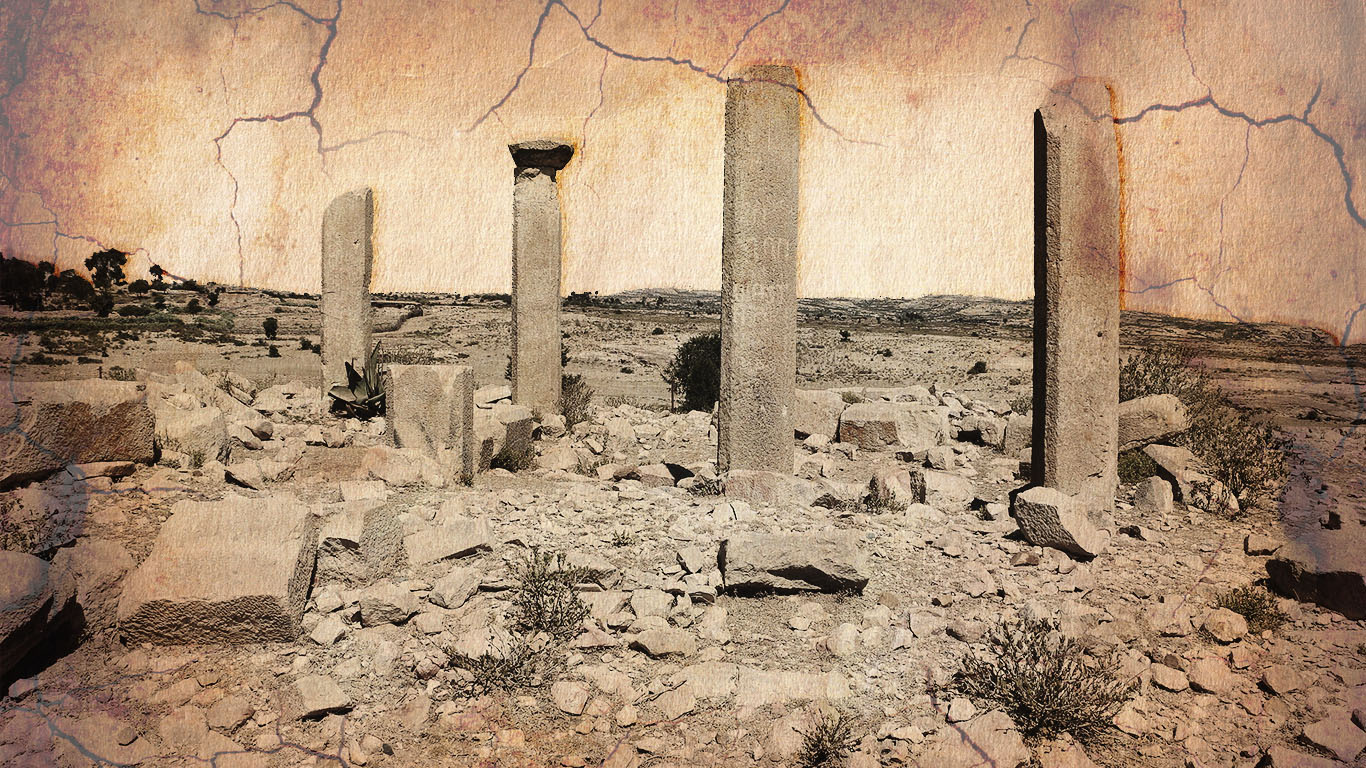 Temple ruins at Qohaito, an ancient trading post between Adulis and Aksum
The Zagwe Dynasty and the Abyssinian Empire
As the Aksumite Empire declined — worn down by the rise of Islam, shifting trade routes, and environmental pressures — the Zagwe dynasty rose to take its place. Centered in what is now Lalibela in northern Ethiopia, the Zagwe rulers dominated much of modern Eritrea during their reign and left behind the extraordinary rock-hewn churches of Lalibela, one of the great pilgrimage sites of medieval Christendom. Their decline, in turn, gave way to the resurgent Abyssinian Empire, which sought to reassert Aksumite claims over the highland peoples of the region.
During this era the coastal lowlands came under pressure from the Adal Sultanate of modern-day Somalia, pressing the inhabitants of the highlands and coast from two directions at once. The landscape of power in the region was constantly shifting, with no single force able to impose lasting control over the whole territory.
The Kingdom of Medri Bahri
Out of this contested landscape emerged one of the most remarkable political entities in Eritrea's pre-colonial history: the Kingdom of Medri Bahri, meaning the land by the sea. The territory between the Red Sea coast and the Mereb River — also known as Maekele Bahr — was ruled by a king who carried the proud title of Bahri Negassi, or King of the Sea.
The Bahri Negassi maintained a complex, ever-shifting relationship with the Abyssinian Empire — sometimes a tribute-paying vassal, sometimes a valued ally, and sometimes an outright rebel. Bahri Negassi Yeshaq was one of the most prominent of these rulers, leading the kingdom through periods of fierce military pressure and navigating alliances on multiple fronts. His revolt against Abyssinia and his campaigns against Gragne and the Turkish invasion defined the highland kingdom's survival strategy for generations.
The Stage is Set
By the mid-16th century, the ancient rhythms of Eritrea's history were about to be broken. The Ottoman Empire — the dominant power of the Near East and the Red Sea — was moving to seize the coastal ports, beginning with the harbour at Massawa. The Kingdom of Medri Bahri would soon find itself squeezed between two imperial forces, setting in motion the long colonial era that followed.