
Eritrean Constitution Adopted By Assembly
10 Jun, 1952
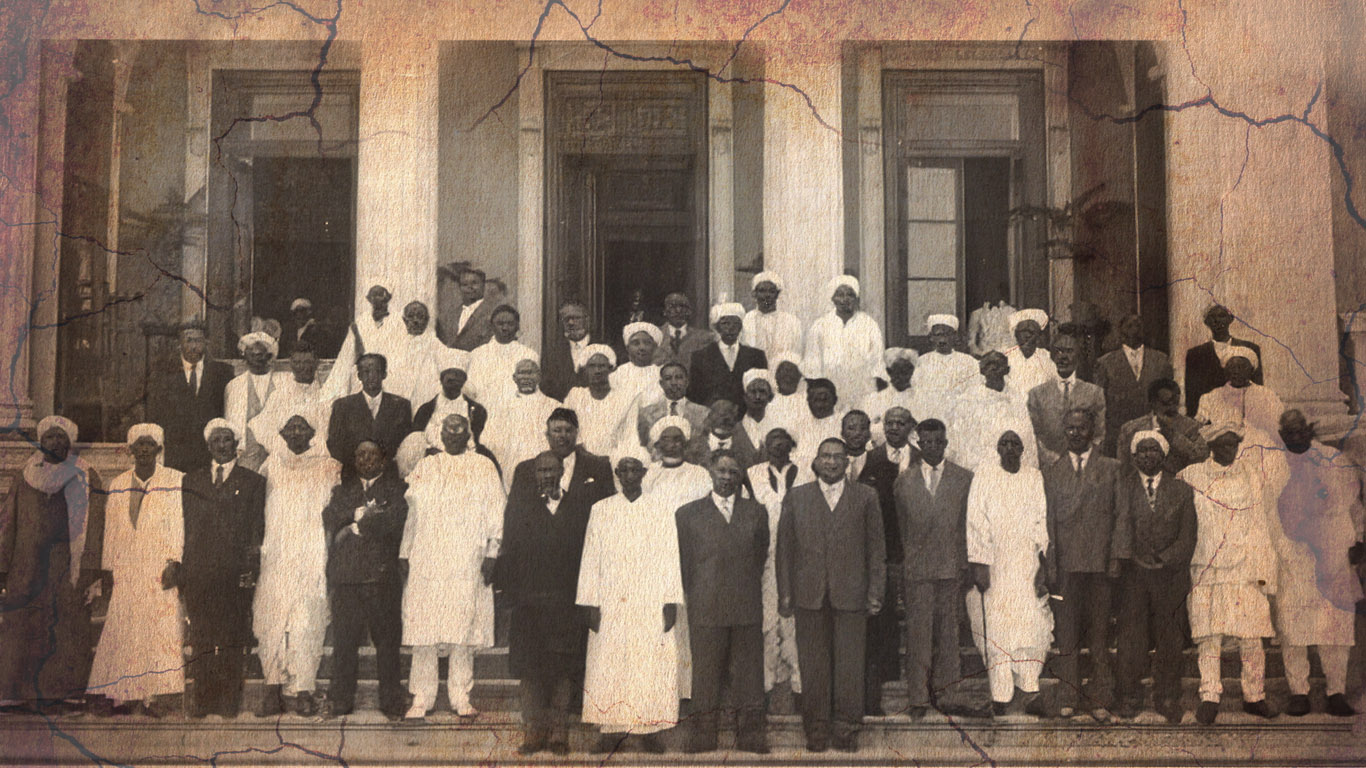 Eritrean Assembly members in the mid 1950s
On June 10, 1952, Eritrea's Representative Assembly voted unanimously to adopt a constitution. Drafted under United Nations mandate, it guaranteed democratic rights, civil liberties, an independent judiciary, and formal autonomy within a federation with Ethiopia.
It would be erased ten years later.
Background
When Italy's colonial possessions were dissolved after World War II, Eritrea passed into British military administration. The United Nations then assumed responsibility for determining the territory's political future.
Eritrean political opinion was divided. The Unionist Party — backed by the Ethiopian imperial government and the Orthodox Church — pressed for union with Ethiopia. The Independence Bloc demanded full sovereignty. The United States, seeking a strategic compromise, sponsored a plan that acknowledged Ethiopia's territorial claims while formally guaranteeing Eritrean autonomy.
UN Resolution 390 and the Federation Plan
In December 1950, the UN General Assembly passed Resolution 390 A (V). The resolution federated Eritrea with Ethiopia under the sovereignty of the Ethiopian Crown, with Eritrea retaining autonomous governance over domestic affairs.
Eritrea would have its own elected assembly, flag, police force and tax authority. The Federal Government in Addis Ababa would control defense, foreign affairs, currency, and international communications. Everything else remained within Eritrean jurisdiction.
The resolution also established a UN Commissioner for Eritrea — Eduardo Anze Matienzo, a Bolivian diplomat — tasked with drafting the constitution that would give the federation its legal structure.
Drafting and Adoption
The drafting process ran through 1951 and into 1952. Matienzo's office drew on Eritrea's existing legal frameworks, shaped by decades of Italian and British administration, and consulted with Eritrean political leaders throughout.
On March 26, 1952, Eritreans voted in the country's first elections by secret ballot, electing the Representative Assembly that would receive and deliberate the draft.
The assembly reviewed and amended the draft over the following months. On July 10, 1952, it adopted the constitution unanimously. UN Commissioner Matienzo formally approved it on August 6. Emperor Haile Selassie I of Ethiopia ratified it on August 11.
Key Provisions
The constitution established a clear separation of powers and defined Eritrean autonomy in concrete terms:
- Articles 1 & 4 — Eritrea's executive, legislative and judicial functions were distinct from the Federal Government. The Eritrean executive was accountable to the elected assembly, not the Imperial Crown.
- Article 5 — Eritrea held authority over education, domestic commerce, public services and local taxation, including the collection of customs and excise revenue.
- Civil Liberties — Freedom of speech, press, assembly and religion were guaranteed. Discrimination on the basis of race, sex, language or religion was prohibited.
- Judicial Independence — A Supreme Court was established with authority to review the constitutionality of laws.
- The Eritrean Flag — A formal marker of Eritrea's status as a distinct political unit within the federation.
Two Incompatible Systems
The federation paired two governance structures with fundamentally different foundations.
The Ethiopian imperial system derived its authority from dynastic succession, divine right, and the loyalty of a landed nobility. Administrative appointments were determined by proximity to the Crown. There was no formal separation of powers.
Eritrea's administrative landscape reflected decades of Italian industrial development and British bureaucratic practice. It had a functioning multiparty system, organized labor unions, an independent press, and a professional civil service accustomed to institutional — rather than personal — accountability.
The Ethiopian imperial court viewed Eritrea's constitutional model as a structural threat. A working democracy with an independent judiciary and free elections, operating visibly within the empire's borders, presented a direct challenge to the premises of feudal absolutism.
Systematic Violations
The imperial government proceeded to dismantle the constitution article by article over the following decade.
Executive subordination. Independent Eritrean officials were progressively replaced with figures loyal to Addis Ababa, reducing the autonomous executive to an instrument of imperial administration.
Language policy. Tigrinya and Arabic — Eritrea's two official languages — were banned from schools and replaced with Amharic, in direct violation of Article 5's protection over education.
Industrial transfer. Eritrean industrial enterprises were dismantled and relocated to Addis Ababa, stripping the territory of economic infrastructure built over decades.
Fiscal expropriation. Eritrea's customs and excise revenues were routed directly to the imperial treasury, eliminating the fiscal independence the constitution had guaranteed.
Suppression of civil liberties. Independent newspapers were censored and shut down. Political parties were banned. Student protests against the erosion of the federation were met with force.
Removal of the flag. The Eritrean flag was ordered taken down — a formal signal that the imperial government no longer recognized Eritrea as an autonomous unit.
Abrogation, 1962
On November 14, 1962, under conditions of military intimidation, the Eritrean Assembly voted to dissolve itself. The federation was declared ended. Eritrea was absorbed as Ethiopia's fourteenth province.
The act had no standing under international law. The UN had created the federation through a General Assembly resolution; no unilateral imperial decree could legally dissolve it. The international community raised no effective objection.
Historical Consequence
The 1952 constitution established, for the first time, a formal legal basis for Eritrean self-governance. Its systematic violation between 1952 and 1962 produced a documented record of deliberate constitutional breach.
The Eritrean Liberation Front was founded in Cairo in 1961 — one year before the formal annexation. The armed independence struggle that followed lasted thirty years. Its foundational grievance was the federation's destruction and the erasure of the rights the 1952 constitution had formally guaranteed.
The complete records of the UN Commissioner's drafting process, the text of Resolution 390 A (V), and the photographic record of the March 26, 1952 elections are archived in the United Nations Digital Library System.